SBA Loan Requirements 2026: How to get approved for an SBA Loan
- SBSS minimum score increased to 165 in 2025, though most lenders require 175+ for actual approval.
- Maximum SBA 7(a) loan size was reduced from $500,000 to $350,000, impacting larger business acquisitions and expansions.
- Merchant Cash Advances can no longer be refinanced with SBA loans, closing a previously common debt consolidation strategy.
- Personal credit scores typically need to be 650+ for basic qualification, with stronger applications showing 680 or higher.
When looking on how to qualify for an SBA loan in 2026, there are key requirements to consider. Since it’s normal for the SBA to institute changes in requirements and lender rules from time to time, keeping up to date on the current requirements helps improve your approval chances for an SBA loan in 2026.
SBA Sets the Floor, Banks Set the Bar: Understanding Both Requirements
The SBA sets minimum benchmarks for guaranteeing business loans. These minimum requirements provide a framework for SBA banks. The SBA then allows banks to set their own SBA loan requirements. These minimum qualifications will differ from bank to bank. For example, one bank may require a minimum credit score of 700, while another bank will be more flexible with personal credit scores. It’s important to understand that the minimum standards fluctuate from bank to bank. Working with FastWaySBA will improve your chances of getting approved for an SBA loan in 2026 because we already know which banks will garner an approval for your business.
What Changed in 2025: New SBA Rules Affecting 2026 Applications
Over the past year, the U.S. Small Business Administration changed several core rules that now act as hard eligibility filters before any bank applies its own lending standards.
These updates affect who can qualify at all. They influence minimum credit thresholds, acceptable uses of funds, maximum loan sizes, collateral expectations, ownership disclosure, and federal debt screening. If an application fails under these updated SBA rules, no lender flexibility can override it.
The following changes, implemented throughout 2025, are now embedded into lender underwriting and will directly determine whether a borrower can qualify for an SBA loan in 2026.
Maximum 7(a) Max Loan Size Was Reduced to $350K
April 21, 2025 The maximum approval amount for 7(a) small loans was reduced from $500,000 to $350,000. This change impacts acquisitions, expansions, and refinances that previously fit within SBA small loan thresholds but now require stronger structures or alternative programs.
SBA Fees and Lender Charges Were Restored
In March 2025, SBA reinstated upfront guaranty fees and lender service fees on new loans, ending the temporary zero-fee period. According to the SBA, this was done to ensure program solvency and comply with statutory zero-subsidy requirements.
Minimum Credit and SBSS Thresholds Increased
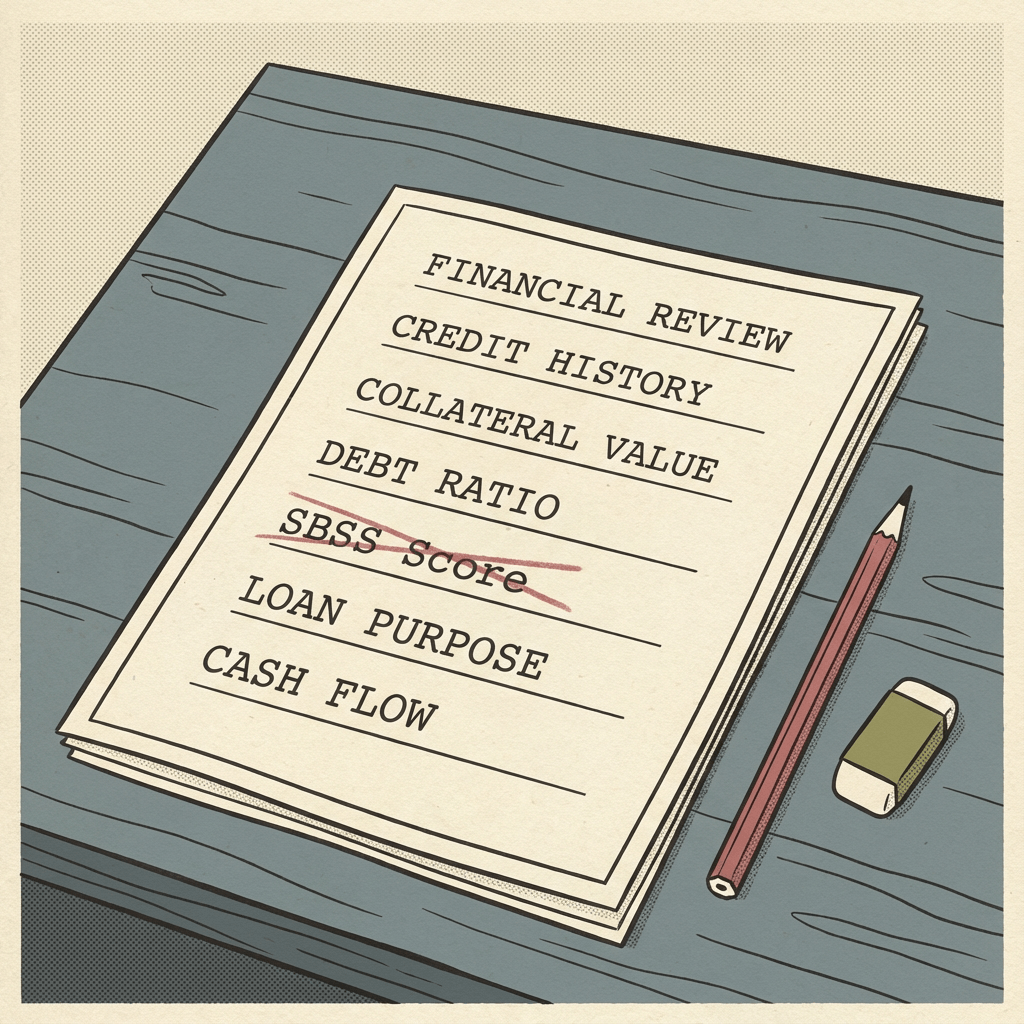
On April 21, 2025, SBA raised the minimum acceptable SBSS score for 7(a) Small Loans from 155 to 165. This directly affects borrowers asking about the minimum credit score for an SBA 7(a) loan. Applicants who previously qualified on thin or borderline credit profiles are now screened out earlier in the process.
Merchant Cash Advance Debt No Longer Able to be Refinanced
That same April 2025 update also eliminated the ability to use SBA loan proceeds to pay off Merchant Cash Advance (MCA) debt. This closes a common workaround where borrowers used SBA loans to clean up high-cost alternative debt after the fact. Since MCA loans can’t be refinanced with SBA loan proceeds, the MCA payments will factor into underwriting and change approvals.
Collateral Expectations Expanded to Smaller Loans
April 21, 2025 SBA also expanded collateral documentation requirements to smaller loan sizes, requiring lenders to more formally document collateral shortfalls instead of relying primarily on cash flow. This marks a shift away from convenience-based approvals and toward asset-backed defensibility, even on loans that were once considered low-risk.
Federal Debt and Prior SBA Loss Checks Are Now Explicit Requirements
In May 2025, SBA updated SOP 50 10 8 to require explicit and documented checks for CAIVRS, unpaid federal debt, and prior SBA losses. Any unresolved federal obligations or prior SBA defaults now function as hard disqualifiers rather than discretionary underwriting concerns.
Ownership Disclosure and Residency Rules Tightened
As of December 19, 2025, SBA now requires 100 percent of owners to be entered into ETRAN, and all owners must reside within the United States. This eliminates silent ownership structures and forces full transparency at the application level.
2026 SBA Standards: The Complete Qualification Checklist
These are the Small Business Administration loan general requirements for 2026 that determine SBA program eligibility and basics before any specific loan type considerations.
Core Business Requirements for an SBA Loan in 2026
- Minimum SBSS Score of 165: Your business must achieve a Small Business Scoring Service (SBSS) score of at least 165 to meet SBA loan requirements. This business credit score threshold, increased from 155 in April 2025, serves as a hard floor that combines your personal credit, business credit, and financial performance into a single lending risk metric. While 165 is the SBA minimum, most lenders require higher scores for actual approvals.
- For-Profit Operating Business: Your business must be for-profit and currently operating. Non-profit entities do not meet SBA loan qualifications. This applies across all SBA loan types - requirements for 7(a), 504, and microloan eligibility all start with for-profit status.
- Independent Ownership: The business must be independently owned and operated, not a subsidiary or division of a publicly-owned entity. This is a fundamental qualification for SBA loan eligibility across all programs.
- U.S. Operations: To meet SBA government loan requirements, your business must be physically located and primarily operate within the United States or its territories. This is among the general requirements SBA loan US programs enforce uniformly.
- Ownership Citizenship: All owners with 20% or more ownership must be U.S. citizens, U.S. nationals, or lawful permanent residents. This citizenship requirement is part of the core eligibility documentation needed for what SBA requires for 7(a) or 504 loans.
- Owner Equity Investment: Owners must have invested their own resources (time, money, or both) into the business. The SBA requires demonstration of owner commitment as part of the qualifications for SBA loan eligibility and criteria across all loan programs.
These Small Business Administration loan requirements 2026 form the baseline that every applicant must meet before addressing specific program criteria or lender standards.
Owner Requirements for an SBA Loan in 2026
Beyond business eligibility, SBA lenders evaluate each owner's personal financial standing and legal status as part of the qualification process. These personal requirements apply to all owners with 20% or greater ownership stake and any individual guaranteeing the loan, regardless of which SBA program you're pursuing. Meeting these thresholds determines whether you can personally guarantee the loan obligation that SBA requires.
"Personal credit is one of the heaviest weights in the SBA approval equation. While your business financials tell the story of where you're going, your personal credit score tells lenders how you've handled obligations when things got tough. That track record often matters more than perfect revenue projections." - Matthew Elling, FastWaySBA
What is the Minimum Credit Score for an SBA Loan?
The general minimum credit score for SBA 7(a) loan approval is 650, though this represents the baseline for SBA loans credit score requirements across most lenders. What credit score do you need for an SBA loan ultimately depends on your lender and loan type - typical SBA 7(a) or CDC 504 credit score thresholds can range from 650 to 680 for standard approvals.
For SBA loan requirements credit score minimums by program:
- SBA 7(a) loan credit score requirements minimum: 650 for most lenders, though stronger applications show 680+
- CDC/504 loans: Generally require 680+ given the real estate component
- Microloans: May accept scores as low as 620-640 depending on the intermediary
The higher your score above these SBA loan requirements credit score baselines, the better your approval chances and potentially your rates and terms.
Additional Owner Qualification Requirements
While credit score forms the foundation of personal qualification, SBA lenders also screen for legal and financial red flags that could jeopardize loan repayment. These additional checks can disqualify an otherwise creditworthy applicant:
No Current Litigation - Each owner and the business cannot be involved in open legal proceedings (divorce, lawsuits, bankruptcy) that could impact repayment ability. This is a standard qualification check beyond just meeting the minimum credit score for SBA 7(a) loan requirements.
Tax Compliance - All federal business and personal taxes must be current or under an active IRS payment plan. Even with payment plans in place, many lenders impose maximum thresholds for tax debt when evaluating what credit score do you need for an SBA loan in practice.
Current on Existing SBA Obligations - The business must be current on all existing SBA loans, including COVID-era EIDL loans. Default or delinquency on prior SBA debt overrides meeting other SBA 7(a) loan credit score requirements minimum thresholds.
These personal requirements work alongside your credit profile to determine overall SBA eligibility beyond just the typical SBA 7(a) or CDC 504 credit score benchmarks.
What is the minimum SBSS required to get an SBA loan?
The minimum SBSS (Small Business Scoring Service) score required for SBA loans is 165 as of the April 2025 updates. This 165 threshold represents the SBA's baseline requirement, but individual banks typically set higher minimums - often requiring SBSS scores of 175-180 for their SBA loan programs. To check your current SBSS score visit sbascore.com.
Your SBSS score combines personal credit, business credit, and financial data to predict loan repayment likelihood. Unlike personal credit scores, SBSS specifically evaluates small business lending risk on a scale up to 300.
What is the minimum gross revenue to be approved for an SBA loan?
Minimum annual gross revenues should exceed $250,000 for most SBA loan approvals, though this represents the practical threshold rather than an SBA mandate. Banks generally view $250,000 in annual revenue as the floor for demonstrating sufficient cash flow to support loan payments. Some lenders may consider businesses with $150,000-$250,000 in revenue for smaller loan amounts or microloans, but approval becomes significantly more challenging below this range.
For SBA 7(a) loans above $350,000, most lenders prefer seeing $500,000+ in annual revenue. CDC/504 loans for real estate typically require even higher revenue levels given the larger loan amounts involved.
⚠️ January 2026 Update
The SBA has announced it will remove the SBSS requirement for 7(a) loans under $350,000, effective February 28, 2026. Lenders will have more flexibility in choosing their own credit models. Read the full breakdown here.
What industries are eligible for SBA loans?
Most legal, for-profit industries can qualify for SBA loans, but several sectors face restrictions or outright ineligibility:
Ineligible Industries:
- Financial/lending institutions (including check cashing, payday loans)
- Life insurance companies
- Multi-level marketing/pyramid sales structures
- Real estate investment/speculation firms
- Gambling establishments (casinos, racetracks, betting)
- Cannabis-related businesses (even in legal states due to federal law)
Restricted Industries (may face additional scrutiny):
- Adult entertainment venues
- Liquor stores (if >50% of revenue from alcohol sales)
- Religious organizations (unless for-profit operations)
To verify your eligibility, confirm your North American Industry Classification System (NAICS) code at https://www.census.gov/naics/. Your NAICS code determines both SBA eligibility and potential size standards for your business category.
Understanding that you meet SBA's minimum requirements is only half the equation. Each bank layers its own lending criteria on top of these SBA baselines.
Your SBSS score has become the new gatekeeping metric. While the SBA sets 165 as the floor, most banks now require 175+ for serious consideration. Check your SBSS score at sbascore.com before starting any application - this single number often determines whether you'll get approved or waste months chasing unlikely lenders.
Critical numbers to verify before applying:
- Your SBSS score at sbascore.com
- Personal credit scores for all 20%+ owners
- Actual revenue (not projected)
- Any existing SBA debt or MCA obligations
The difference between rejection and approval often isn't improving your application but it's finding the right lender whose risk appetite aligns with your business reality. This targeted approach saves months of declined applications and credit pulls that further damage your scores. FastwaySBA maintains current lending criteria for over 100 SBA-approved banks and lenders. We know which lenders flex on credit, which prioritize cash flow over collateral, and which understand specific industries. Ready to match with the right lender for your profile? Apply at fastwaysba.com or schedule a call to discuss your qualifications.

.svg)

.svg)




.png)